TRUSOL JOURNAL · MATERIAL GUIDE
Solid Surface vs Composite Stone (Quartz): Which Is Better for Bathtubs, Basins and Vanity Tops?
Solid surface and composite stone can look almost identical in a showroom, so they are often mixed up. Their make-up, how they are formed and how they are repaired are quite different, and that decides where each one works best. This guide explains the difference in plain terms and helps you choose the right material for a freestanding bathtub, a basin or a vanity top, whether you are renovating a condo in Bangkok or fitting out a villa in Phuket.

Are solid surface and composite stone the same material?
No. Solid surface is made of resin (acrylic, or acrylic blended with polyester) mixed with fine minerals into one uniform, non-porous material that can be joined seamlessly and formed into curves. Composite stone, including engineered quartz, is a high proportion of crushed stone or quartz bound with resin and pressed into slabs: it is harder and more scratch-resistant, but it cannot be bent and its joints are more visible. That is why shaped bathtubs and basins are usually made in solid surface.
01 / SOLID SURFACE
What is solid surface?
Solid surface is a surfacing material made from resin, fine mineral filler and pigment. Proportions vary between brands and product lines, but the principle is the same: the colour and material are consistent through the full thickness.
Same material all the way through
Colour and pattern run through the full thickness, so light scratches can be sanded out without changing the colour.
Non-porous surface
Water and stains find it hard to soak in, so it is easy to clean and hygienic for wet areas.
Seamless joints
Pieces are bonded with a matching adhesive and then sanded, so a basin and vanity top can become one continuous piece.
Free-form shapes
It can be cast into bathtub shapes or heat-bent (thermoformed), depending on the formulation and thickness.
02 / COMPOSITE STONE
What is composite stone?
Composite stone is made by crushing natural stone or quartz crystals and mixing them with resin as a binder, then pressing and curing the mix into large slabs. The most common type is engineered quartz, which has a very high mineral content. The result is hard, scratch-resistant and has a speckled look close to natural stone.
The trade-off is that it is a rigid slab: it cannot be bent or cast into a seamless curved bathtub, and chips or cracks are harder to repair invisibly.
Watch the names: suppliers use terms such as solid surface, stone resin, cast stone and engineered stone in different ways. Before you buy, ask whether the product is a pressed slab or a cast piece, which resin it uses, and whether there is a care guide for that model.
03 / COMPARE
Solid surface vs composite stone: side-by-side comparison
| Feature | Solid surface | Composite stone / quartz |
|---|---|---|
| Main ingredients | Acrylic or acrylic-polyester resin + fine minerals + pigment | High proportion of crushed stone or quartz + resin binder |
| How it is made | Cast into finished pieces (bathtubs, basins) or made as sheets | Pressed into slabs, then cut to size |
| Porosity | Non-porous | Non-porous (unlike natural stone, which needs sealing) |
| Joints | Bonded and sanded until almost invisible | Joint lines are visible, especially with speckled patterns |
| Curves and shaping | Yes – suits curved and custom pieces | No – suits straight runs |
| Hardness / scratches | Scratches more easily, but can be resurfaced | Harder and more scratch-resistant |
| Repair | Scratches can be repaired and the surface refinished fairly easily | Chips and cracks are hard to repair invisibly |
| Heat | Heat resistant in normal use; use a trivet for hot items | Heat resistant in normal use; use a trivet for hot items |
| Best for | Bathtubs, basins, seamless vanity tops, curved pieces | Kitchen worktops, table tops, heavy-use surfaces |
04 / RESIN SYSTEM
100% acrylic vs acrylic-polyester solid surface: what is the difference?
Solid surface falls into two main groups by resin system. "100% acrylic" means the resin is entirely acrylic; it does not mean the whole piece is acrylic with no mineral content.
100% acrylic
Pure acrylic resin with minerals and additives. Thermoforms well and has even colour and pattern across the sheet, so it suits work that needs curves and specific radii.
Acrylic-polyester blend
Part of the acrylic is replaced with polyester resin. Strong and non-absorbent, but harder to bend, so it suits cast shapes and flat panels.
For either group, choose by the data and care guide for the specific product rather than by the name of the formulation alone.
05 / HOW TO CHOOSE
Which material should you choose for each job?
Bathtubs and basins: choose solid surface
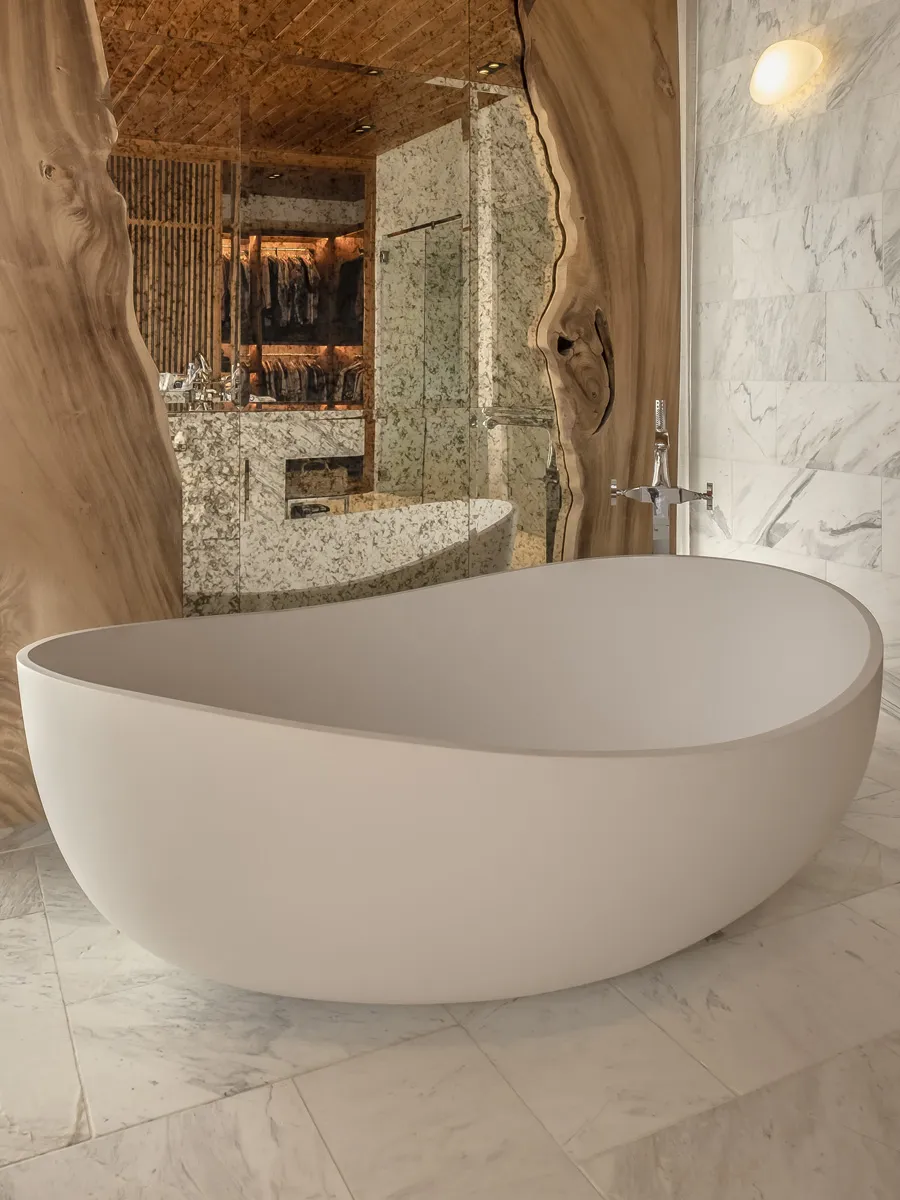
Freestanding bathtubs, countertop basins and pedestal basins need continuous curves and a smooth, seamless finish, which is exactly where solid surface excels. It also feels warmer to the touch than stone and can be refinished after years of use. If you are also weighing up acrylic tubs, see our guide to buying a bathtub in Thailand.
Vanity top with basin
Solid surface joins basin and top into one piece, with no grooves for grime to collect in.
Heavy-use kitchen worktops
Composite stone or quartz handles knife marks and knocks better.
Curved or custom pieces
Solid surface can be made to your design. Ask about custom fabrication.
Semi-outdoor areas
Sun and temperature affect every material. For pool villas and open-air bathrooms, talk to our team to choose the right material grade.
06 / CARE
How do you care for a solid surface bathtub or basin?
- Wipe after use. Use a clean, damp cloth to remove water marks and soap residue before they dry and build up.
- Use mild cleaners. Washing-up liquid or a mild cleaner is ideal; the material resists common household cleaning products.
- Avoid sharp objects and abrasives. No steel wool, scouring powder or stiff brushes, as they scratch the surface.
- Use a trivet for hot items. Do not place hot pans, hair dryers or hair straighteners directly on the surface.
- Refresh minor marks. Fine hairline scratches on a matte finish can be buffed out with a solid surface care kit, or by our technicians.
TRUSOL
Solid surface bathware by TRUSOL
TRUSOL is a Thai brand that designs and makes solid surface bathtubs and basins: freestanding bathtubs, countertop basins, integrated basins with vanity tops, pedestal basins and made-to-order pieces. Every piece has a smooth, even-coloured, seamless and easy-care finish.
Browse bathtubs and basins, download the catalogue, or see the materials in person at our showrooms in Bangkok (South Sathorn) and Phuket. We welcome project enquiries from homeowners, interior designers and developers across Thailand, from Bangkok to Phuket and Samui.
07 / FAQ
Frequently asked questions
Is solid surface the same as composite stone?
No. Solid surface uses resin mixed with fine minerals into one uniform material that can be shaped, while composite stone uses a high proportion of crushed stone or quartz pressed with resin into rigid slabs.
Does solid surface contain natural minerals?
Yes. Most solid surface uses fine minerals as a main ingredient together with resin. Proportions differ by brand and model, so check the material data for the product you choose.
Which is better for a bathtub, solid surface or quartz?
Solid surface. It can be cast into curved shapes, is non-porous and seamless, and surface scratches can be repaired. Composite stone is a rigid slab that cannot be formed into a curved bathtub.
What is the difference between composite stone and quartz?
Engineered quartz is one type of composite stone that uses crushed quartz crystals as its main ingredient. "Composite stone" can also refer to other formulations, so ask about the ingredients and manufacturing method of the specific product.
Does solid surface scratch easily, and can it be repaired?
It scratches more easily than quartz, but because the colour runs through the full thickness, the surface can be sanded and refinished to look smooth again.
Can I put hot items on solid surface?
Solid surface is heat resistant in normal use, but always use a trivet and do not place hot pans or hair styling tools directly on the surface.
How should I clean a solid surface bathtub?
Use a damp cloth with a mild cleaner, and avoid scouring powder, steel wool and stiff brushes.
Can I see TRUSOL bathtubs in person?
Yes. You can visit the TRUSOL showrooms in Bangkok (South Sathorn) and Phuket, or contact the team to discuss your project.
Talk to the TRUSOL team about materials and bathtubs
Send us your bathroom plan or reference images and we will recommend models, colours and installation options for your space.
Bangkok +66 80 294 0005 · Phuket +66 62 385 7571 · Email [email protected]